
Simple step by step
Short instructions to adjust the movement, such as sitting tall, leaning the trunk from the hips and keeping your gaze forward.
TechniqueEBOOK FOR OC6, V1 AND V3 PADDLERS
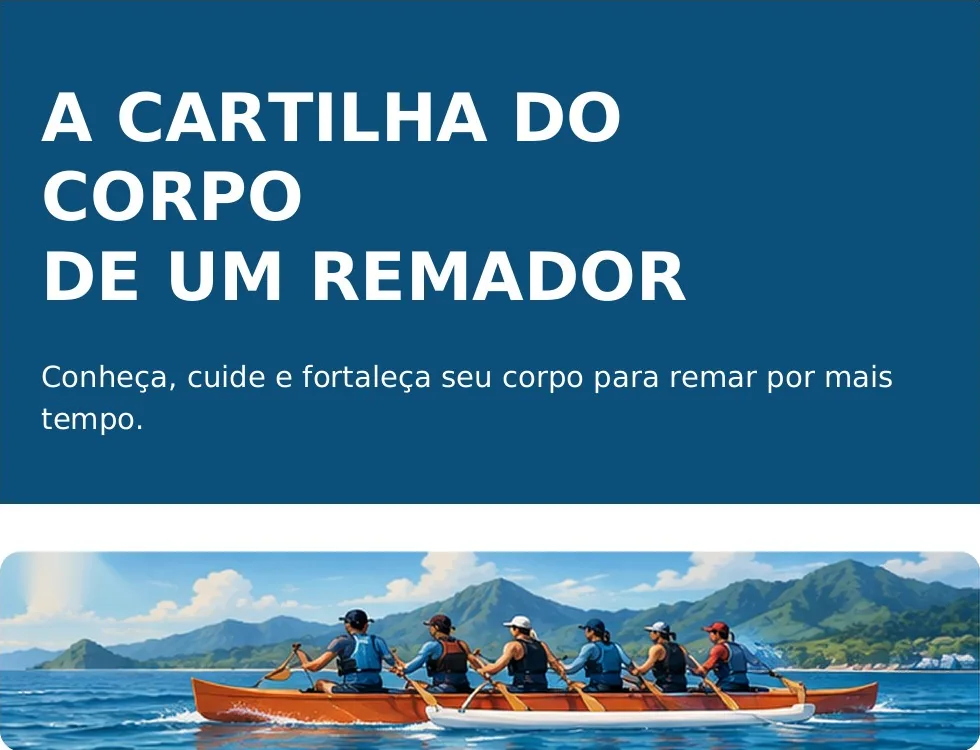
An illustrated, practical guide for beginners in Hawaiian and Polynesian outrigger canoe (va’a): know, care for and strengthen your body to keep paddling for longer.
The eBook is written in Portuguese. Purchase is made on the product page on Hotmart.
WHAT REALLY MATTERS
The arms tire first, the shoulder complains and the lower back takes on work that isn’t its own.
Good paddling uses the whole body as a chain: feet, legs, hips, trunk, shoulders and only then the arms. Power doesn’t start in the arms: it comes from the foot brace, passes through the legs, hips and trunk, and reaches the paddle blade.
The primer walks through each link of that chain in plain language, with illustrations. Its golden rule applies to every paddler: progress gradually. The people who add training volume too fast are the ones who get hurt most.
You also know what to warm up before getting in the water, what to strengthen outside it and how to recover, so you can improve without getting hurt.
CONTENTS
From the integrated paddling movement to paddling for life.
Get the eBook on HotmartPaddling is one integrated movement: power starts at the feet and passes through legs, hips and trunk.
Efficiency starts with alignment: head, gaze, shoulders and spine.
Back, chest, shoulders, core, legs and glutes: a team inside the body.
Shoulder, spine, hip, knee and ankle: mobility with stability.
The base for transferring power: what rotates and what stabilizes.
The center of stability, power and rotation.
Control before strength, to protect the body’s most mobile joint.
Support inside the canoe, with adjustments for OC6, V1 and V3.
A rhythm to sustain effort, without holding your breath during hard strokes.
Listen to your body: shoulder, lower back, elbow, wrist and knee.
Strength, endurance, mobility, stability and conditioning, with a simple weekly model.
Sleep, nutrition, hydration and self-care: resting is training too.
Before, during and after the water, with a daily checklist.
Health, movement and connection, with consistency and good instructors.
HOW EACH CHAPTER WORKS
Short, illustrated reading designed to become practice at your next session.
Short instructions to adjust the movement, such as sitting tall, leaning the trunk from the hips and keeping your gaze forward.
TechniqueThe most frequent slip for each part of the body, so you can spot and fix it before it turns into pain.
PreventionDirect questions to take to the water, like “are my feet braced?” and “does my trunk rotate with the paddle?”.
Self-checkOne to two minutes, to use right away: plank, glute bridge, spine mobility, diaphragmatic breathing and more.
PracticeIMPLEMENTATION PLAN
The eBook ends with a plan to put everything into practice, without rushing and without complications.
Do the chapter 13 warm-up, try the chapter 9 breathing exercise and pick 2 days of the week for strengthening.
2 strengthening sessions, 5 minutes of mobility a day and one question to your instructor about a point of your technique.
Warm up on your own, paddle with your trunk rotating and finish the session without lingering pain. After each session, note how your shoulder, lower back and fatigue felt, from 0 to 10.
WHO IT’S FOR
WHO WROTE IT
The primer is by Jorge Luiz, a paddler and steersman of Hawaiian and Polynesian outrigger canoe (V1, V3 and OC6) and the creator of CRM VAA PRO. Paddling content and tips on Instagram and YouTube at @jorgeluizremadorvaa.
Educational material. It does not replace medical or physical therapy guidance, or the advice of physical education professionals.
READY TO PADDLE BETTER?
Meet The Paddler’s Body Primer and start with today’s plan.
WHATSAPP COMMUNITY
A free group for owners and managers of Hawaiian and Polynesian outrigger canoe schools. The idea is to share practical content on attracting students, trial classes, attendance, finances and retention, and also to gradually introduce CRM VAA PRO, a VAA TECH project built for this world. The group is in Portuguese.